5 min read

The Truck Isn't Yours. The Duty Still Is: What Councils Can Specify About Waste Collection Safety

The Truck Isn't Yours. The Duty Still Is: What Councils Can Specify About Waste Collection Safety
8:47

For most Australian councils, the waste collection fleet belongs to somebody else.

Collection is contracted out, the trucks carry a contractor's logo, and the drivers and runners are a contractor's employees. It is easy to read that arrangement as a transfer of risk. It is not. The kerbside is still a council space, the residents are still a council's community, and under work health and safety law the duty a council holds for that work does not move across with the contract.

What Contracting Out Does Not Do

Under the model Work Health and Safety Act, you cannot hand a safety duty to someone else (s 14). Two organisations can hold the same duty at the same time, and each must comply to the extent it has the capacity to influence and control the matter (s 16). Where duties overlap, each holder must consult, co-operate and co-ordinate with the others, so far as is reasonably practicable (s 46). This applies everywhere in Australia except Victoria, where the equivalent duties sit under the Occupational Health and Safety Act 2004 (Safe Work Australia).

The practical effect for a council is straightforward. Engaging a contractor to collect waste does not end the council's interest in how that collection is done. It creates an obligation to understand how it is done, and to coordinate with the operator on the risks the two organisations share. A council that has never asked its contractor what controls are fitted to the trucks is not well placed to demonstrate it has discharged that duty.

The Risk Sits at the Kerb, Not in the Depot

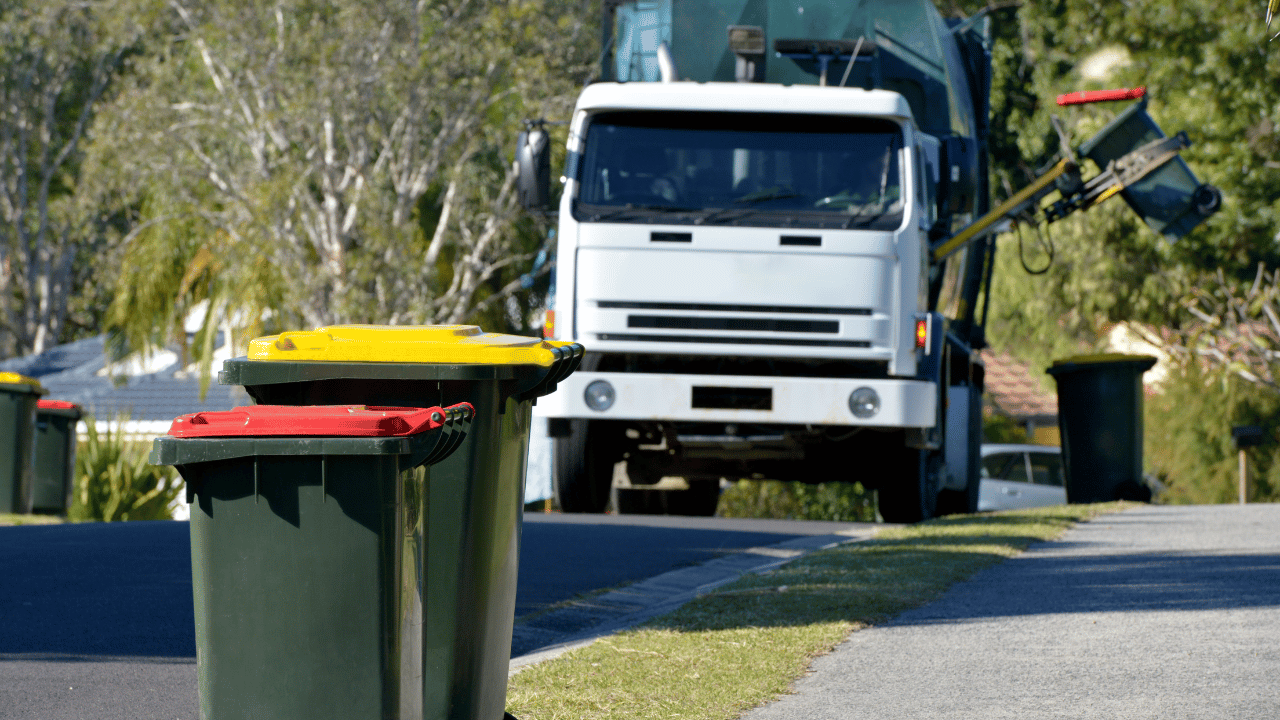
A residential waste collection run is one of the few heavy vehicle operations where the truck and its crew are almost never still. The vehicle stops, starts, reverses and turns dozens of times an hour. A runner may be working from the back step or moving on foot between the truck and the kerb, or inside the basement bin rooms of residential apartment buildings. Bins are wheeled out at odd angles, often by a resident who has heard the truck coming. Cars are parked tight to the road edge, and children, cyclists and pets move unpredictably around driveways and nature strips.

Councils carry a version of this risk that private operators do not. Collection routes run past schools at drop-off, past aged care facilities and past footpath users who are residents of the same organisation that engaged the truck. When something goes wrong at the kerb, the council is not a bystander to it.

The severe end of that risk is well documented, and the person killed is not always a worker. On 1 October 2025, a 78-year-old man was struck by a reversing truck at the Mugga Lane Resource Management Centre in Symonston, ACT, and pushed into the rubbish collection area, suffering head injuries he later died from in hospital. Because the collision occurred in a road-related area, ACT Policing is treating the death as a road fatality, its Major Collision Team is investigating, and a report is being prepared for the coroner (Region Canberra, 2025).

The Symonston collision happened on a tip site rather than a street, but the exposure it describes — a pedestrian on foot behind a reversing waste truck, in a space the law treats as road-related — is the exposure a residential collection run creates dozens of times a shift, without any of the traffic management a site can impose. Events of that severity are rare, and a council risk register that only counts fatalities will conclude the risk is remote. The frequency sits elsewhere: contact with parked cars, mirror strikes, driveway and letterbox damage, and near misses. When those are reported at all, they are rarely investigated closely enough to prevent the next one. Those are the events that appear in claims data and in renewal conversations with an insurer or mutual. They are produced by the same operating pattern as the rare catastrophic one, which is why a control that addresses the pattern addresses both.

The Industry Code Already Names the Control

The NHVR registered a Waste and Recycling Industry Code of Practice in June 2024. Under its controls for injury to persons during vehicle operations, it directs operators to install electronic driver aids and train drivers in their use, naming reversing cameras, blind spot cameras and vulnerable road user detection systems as examples (NHVR, 2024).

That matters for a council. A specification asking a contractor to fit detection technology is not a council inventing a requirement, and it is not a vendor's recommendation. It is a council asking an operator to work to a standard the operator's own industry has already published.

What a Council Can Actually Specify

In a contracted model, the lever is not a purchase order. It is the tender document and the contract that follows it. Five things are worth putting in writing:

  • Specification. State the controls required, not just the safety outcome. Detection coverage around the vehicle, in-cab alerting, event logging, and who is responsible for calibration and servicing.
  • Evaluation criteria. Give safety technology explicit weighting rather than leaving it inside a general WHS response. What is not weighted is not priced, and what is not priced is not fitted.
  • Conformance through the term. Fitment at mobilisation is not the same as fitment in year three. Ask for periodic evidence that systems are installed, functional and correctly configured.
  • Configuration, not just fitment. A detection zone set too wide for a residential street produces near-constant alerts, and drivers learn to tune them out. Zone design belongs in the specification, not left to the installer.
  • Data access. Agree at the outset that detection and near-miss event data is shared with the council rather than held solely by the contractor.

That last clause is the most under-used one available to councils, and it is the one worth arguing for.

The Data Is Worth More Than the Alert

An alert protects one person on one day. A year of logged detection events tells a council where risk concentrates across its own network: which streets, which times of day, which collection points. That is information a council can act on using controls no contractor holds.

  • Shifting the collection window at a school or aged care facility
  • Redesigning a run to remove a reversing manoeuvre from a cul-de-sac
  • Changing bin placement guidance on a problem street
  • Targeting resident communication where near misses cluster

Those are higher-order controls than a warning alarm, and they sit with the council rather than the operator. Detection technology is what makes them visible in the first place, which means the case for it is not only a safety case. It is also a service planning case, and that tends to travel further inside a council than a safety case alone.

Two Considerations Specific to Councils

Two points come up in council conversations that rarely arise with private operators, and both affect timing more than they affect the technical case:

  • Noise. Early morning collection already generates complaints, and external reversing alarms contribute to them. The answer is not to remove the reversing alarm, which regulators expect to be fitted and working. It is that in-cab detection and alerting adds a layer the alarm cannot provide, improving what the driver actually knows without adding to the noise a council must field complaints about.
  • Timing. In a contracted model the capital is not the council's to spend, so the practical moment to raise this is before a specification is written or a contract varied, not after an incident. Contract renewal timetables, not budget cycles, set the window

A Practical Next Step

For a council fleet, risk or waste services team, the starting point is not procurement. It is a current picture of where crew and public proximity is at the highest risk across the collection network, and an honest answer to whether the controls in the existing contract are matched to it. In many cases the answer will be that nobody has asked.

Councils wanting to structure that review can use the Waste Collection Vulnerable Road User Risk Assessment Template, which sets out the common proximity scenarios on a residential collection route and the control measures relevant to each, mapped against the requirements of the Waste and Recycling Industry Code of Practice.

Heavy Vehicle Safety Requirements Information Pack


Discover more related news

The Blind Spot Behind Every Bin

The Blind Spot Behind Every Bin

Waste collection is one of the few heavy vehicle operations where the truck and its crew are almost never still.
Read More
Improving Truck Driver Visibility with MAX-SAFE

Improving Truck Driver Visibility with MAX-SAFE

Blind spots at the front, corner and sides of heavy vehicles are often the main cause of collisions with vulnerable road users, resulting in...

Read More
What Heavy Vehicles Can’t See: Understanding Blind Spot Risk and the Case for Active Monitoring

What Heavy Vehicles Can’t See: Understanding Blind Spot Risk and the Case for Active Monitoring

We are blind to the blind spots. Simply watch this video to see how people are exposed to fatal accidents due to the blind spots in heavy vehicles....

Read More