Blue Bus
Case Study
CLIENT:
Blue Bus
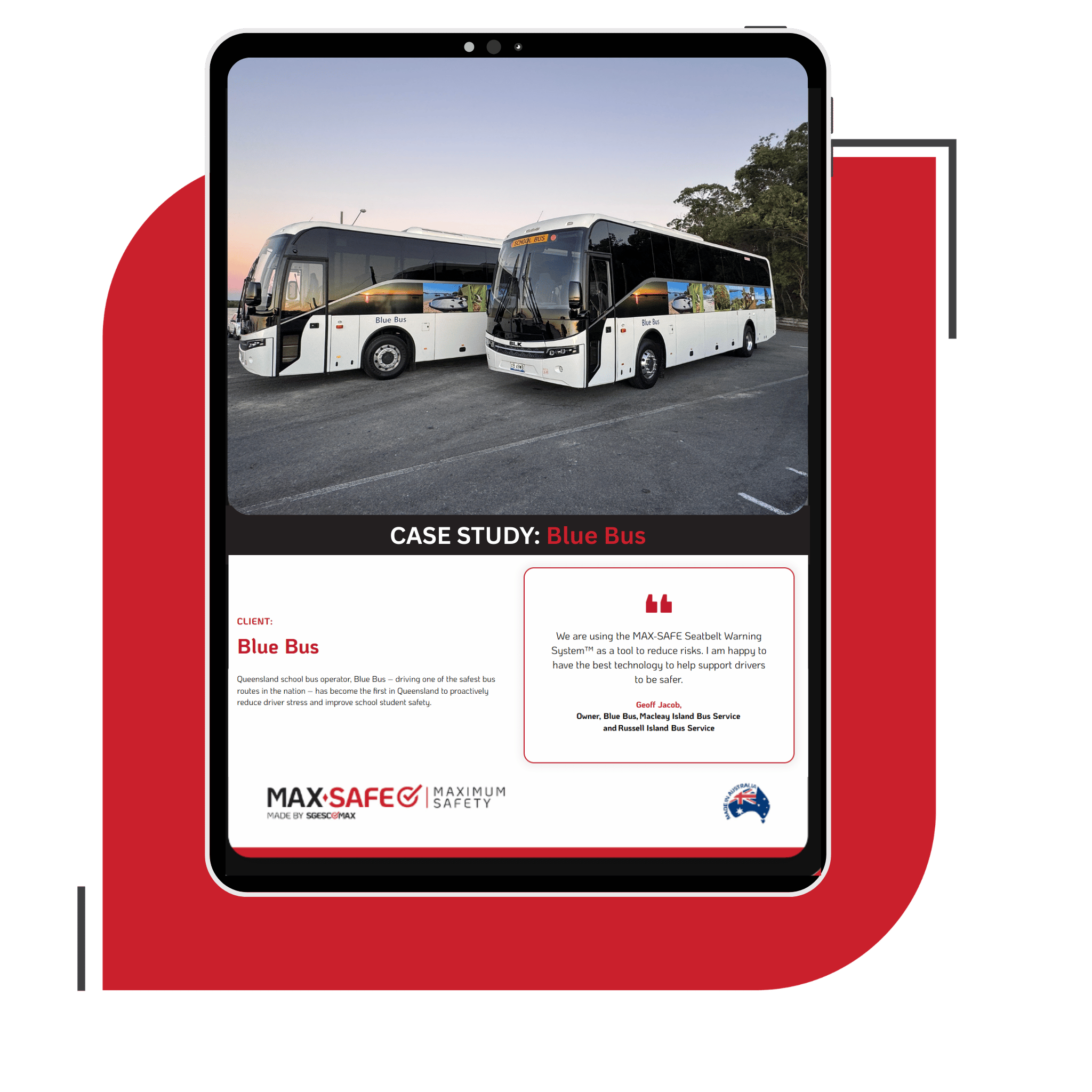
Queensland school bus operator, Blue Bus – driving one of the safest bus routes in the nation – has become the first in Queensland to proactively reduce driver stress and improve school student safety.
We are using the MAX-SAFE Seatbelt Warning System™ as a tool to reduce risks. I am happy to have the best technology to help support drivers to be safer.
Geoff Jacob,
Owner, Blue Bus, Macleay Island Bus Service
and Russell Island Bus Service
Snapshot
Brisbane-based family operator Blue Bus has become the first school bus company in Queensland to install a MAX-SAFE seatbelt monitoring solution on its school fleet.
Operating on two island routes in Moreton Bay with some of the lowest posted speed limits in Queensland, Blue Bus still identified an obvious and foreseeable safety risk: drivers being distracted while trying to monitor dozens of students behind them.
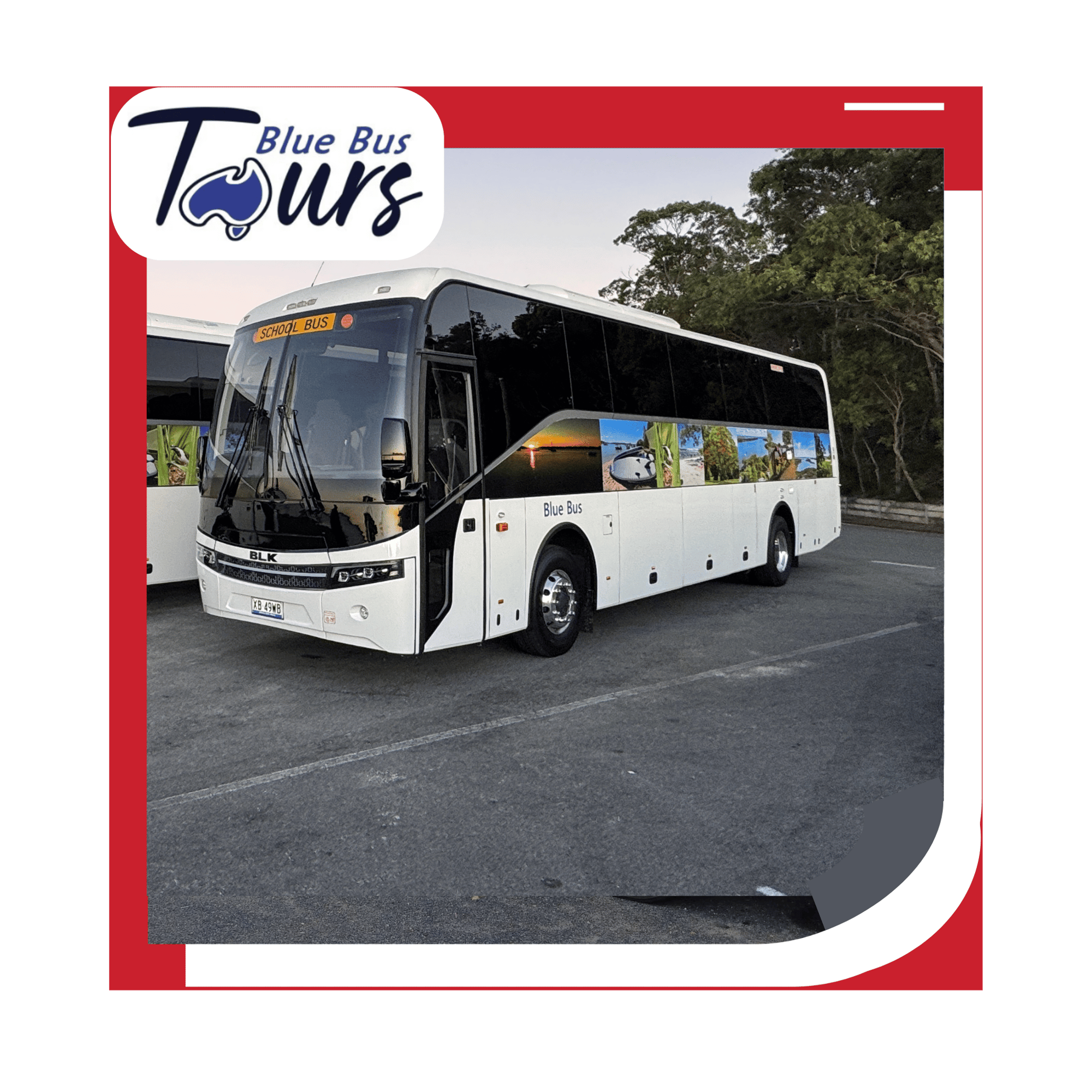
In mid-2025, Blue Bus installed the MAX-SAFE Seatbelt Warning System™, developed by SGESCO-MAX, on two newly purchased BLK President 2 coaches servicing Russell Island and Macleay Island school contracts under the Queensland Government School Bus Upgrade Scheme.
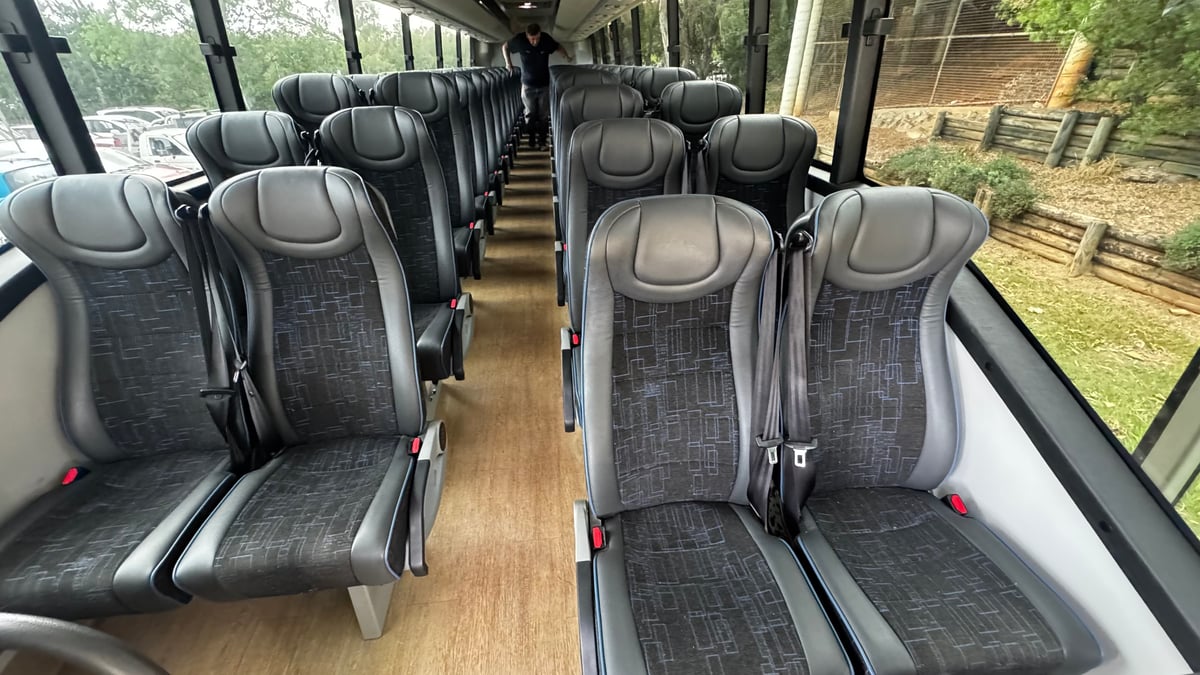
The MAX-SAFE Seatbelt Warning System™ is an intelligent sensor-based system that monitors seatbelt usage for all passengers and provides the driver with both audible and visual alerts when seatbelts are not properly fastened, thereby allowing the driver to ensure safe transport.
Read on for details on:
- Business overview
- The safety challenge
- Why seatbelt monitoring
- The solution
- Implementation and adjustment
- Driver response
- Outcomes and benefits
-
Business Overview
Blue Bus is a family-owned bus and charter operator based in the Redlands, east of Brisbane. The company has operated school bus services on Russell Island since 2002 and Macleay Island since 2004.
The two Southern Moreton Bay Islands services operate during school terms. Secondary students are collected from 7am, travelling by bus to ferry terminals for onward transit to the mainland, while primary students attend local island schools.
The Blue Bus fleet consists of 11 buses, with two vehicles dedicated to the island school runs, driven by five experienced drivers across the island services.
Having always been an adopter of new safety technology, in mid-2025, Blue Bus purchased two new 57-seat buses with the support of Queensland Transport School Bus Upgrade Scheme specifically for the island routes. Blue Bus also made the decision to install a seatbelt monitoring system on the BLK vehicles.
-
The Safety Challenge
From a risk perspective, the island routes are often regarded as low risk. Narrow winding roads necessitate a maximum speed limit of 60 km/hour, which is manageable due to low traffic volumes.
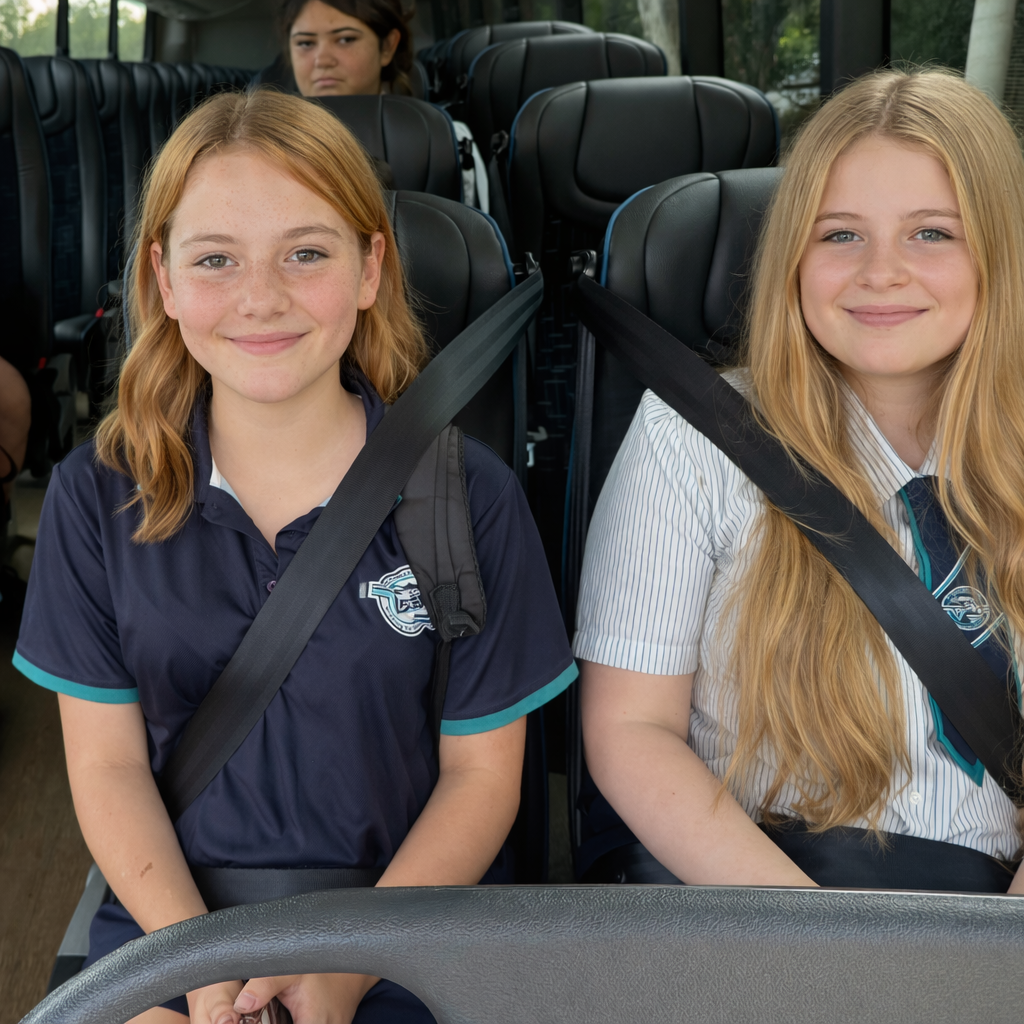
From a driver’s perspective, however, the risk profile looks different. As of 2009 Queensland Road Rules – like those in other jurisdictions – require occupants to wear seatbelts if a bus has them.
Blue Bus school drivers can be responsible for monitoring up to 57 children seated behind them, while navigating tight, visibly restrictive roads, ferry timetables and unpredictable student behaviour.
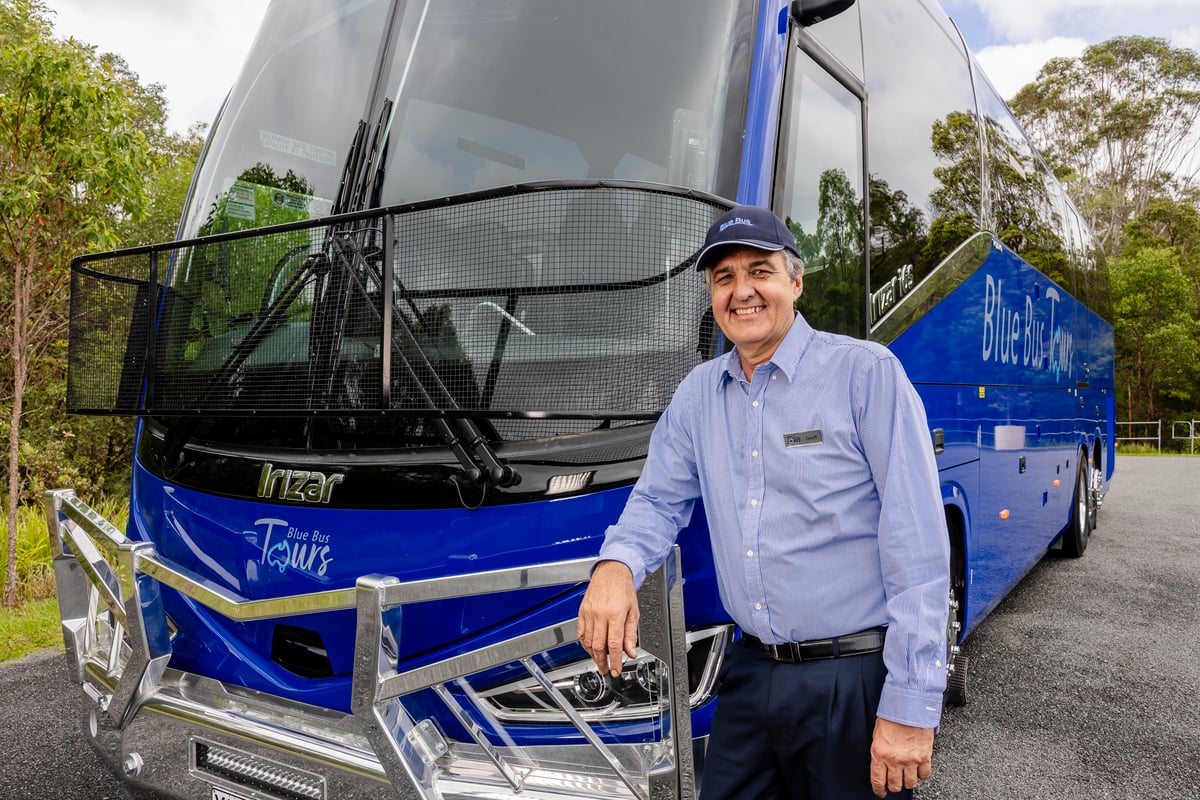
“Drivers would regularly be checking mirrors to see if kids were seated and belted,” said Geoff Jacob, Owner of Blue Bus. “That means their eyes were not on the road, and that’s a risk in itself.”
Primary school students can struggle to remain seated. Wanting to sit with friends, turning around to talk, or moving around the bus creates distraction and stress for drivers.
“We don’t ask teachers to manage a classroom of 30 kids without support,” said Geoff.
“Yet we expect a driver to manage up to 57 children while driving a heavy vehicle. This can make for an incredibly stressful and hazardous situation.”Thus, for Blue Bus, the safety challenge was not whether seatbelts were fitted. It was ensuring they were being worn properly, consistently, and without placing additional cognitive load on drivers.
-
Why a Seatbelt Monitoring System?
Geoff’s decision to install a seatbelt monitoring system was driven by four key factors.
-
Reducing driver stress and distraction
Drivers were increasingly spending time checking rear mirrors instead of watching the road. “The job of the driver is to drive,” said Geoff. “I believe if we can remove distractions, we should.” -
Learning from real-world tragedy
The 2023 Hunter Valley bus rollover in New South Wales, where ten people lost their lives, another 25 were hospitalised and the driver jailed for 32 years, was a sobering reminder of what can happen when occupants are unrestrained. -
Being proactive, not reactive
Geoff wanted to act before an incident occurred, not after. -
A long-standing commitment to safety and technology
Blue Bus has a history of adopting safety technology early, including CCTV systems (now a legal requirement), Geotab vehicle monitoring and the driver fatigue management system Guardian by Seeing Machines used in their charter coaches and Blue Bus Tours Coach.
“I would never want one of our drivers or students to go through what happened in the Hunter Valley,” said Geoff. “I want our drivers to come home safely. If they do, everyone else does.”
New Legislation in 2026
Seatbelt legislation for buses has evolved significantly over time.
While older school buses were not originally fitted with seatbelts, Queensland regulations now require seatbelt use where belts are installed. From November 2026, new Australian Design Rules will require visual and audible seatbelt reminders on new buses fitted with seatbelts.
Blue Bus did not wait for this requirement.
“To be honest, we have one of the lowest risk situations in Australia,” said Geoff. “Because the roads are narrow, you can’t go over 60Km/hour anywhere on the island. Still, I did not see that as a reason not to do this.”
-
-
The Solution
The MAX-SAFE Seatbelt Warning System™ is designed to continuously monitor seatbelt usage across all passenger seats.
The system:
- Monitors both seat occupancy and buckle status
- Identifies unbuckled occupants accurately
- Alerts the driver only when there is an issue
- Eliminates false alerts from empty seats
Visual and audible alerts notify the driver if a seatbelt becomes unlatched, allowing them to respond without turning around or leaving their seat.By providing clear, reliable information, the system allows drivers to stay focused on driving while maintaining compliance.

-
The Implementation
The two new BLK President 2 buses were purchased through BLK Auto in Yatala, on Brisbane’s southside.
Both vehicles were delivered with Sege seating and buckle configurations compatible with the MAX-SAFE system.
SGESCO-MAX worked directly with BLK Auto’s preferred third party contractor, Transfab, to install the system.
Following installation, the system was adjusted to suit the realities of school bus operations.
“In a standard setup, alerts can trigger within seconds of the door closing,” said Geoff. “We found for school kids – and our drivers – that was too tight.”
Working with SGESCO-MAX technicians, the alert was extended to approximately 20 seconds, allowing students time to sit down and buckle up before alerts were triggered.
-
Driver Response
Some of the drivers questioned whether the new seatbelt monitoring system was necessary because they had spent decades operating buses without one.
Geoff explained that it was an important support measure to improve safety and reduce stress on drivers.
“As a bus driver and operator there are a lot more pressures on you now – compared to a few decades ago,” he noted. “Drivers are more heavily scrutinised for how they drive and how they manage situations in line with community, parent and government expectations.”
Once drivers understood where Geoff was coming from, they were more supportive.
After six months with the safety system and understanding that it’s a work in progress to tailor it to their specific needs, they have come to appreciate the benefits it provides, added Geoff.
“New systems take time to bed down and tweak to get right and that has been our experience,” said Geoff. “The original timings on the alert systems were too tight for school children and a bit of a challenge for drivers to begin with. We have fixed that. Now we start 2026 with a solid safety system in place to support our drivers and school families.”
-
Outcomes
Blue Bus is using the MAX-SAFE Seatbelt Warning System as a tool to reduce stress on drivers and reduce the risks, in particular distraction by children on buses, said Geoff. “It’s an obvious and foreseeable risk and it’s my responsibility to address it and ensure my drivers can operate safely.”
For Blue Bus the solution is providing:
- Immediate and safe alerts if a student unbuckles
- Clear accountability for student behaviour
- Less driver distraction and lower stress levels
- Greater schedule punctuality
“If a student doesn’t do the right thing, we won’t get to the ferry on time, or they will be late to school or getting home. Our driver won’t drive if the situation is not safe. That’s clear to students, parents and schools.”Another plus is if there are behaviour or other issues, the driver knows who is responsible. Matters can be professionally and accurately escalated to parents or the school if required.
Looking Ahead
Geoff welcomed the news that in 2026 it will become compulsory for new buses fitted with seatbelts to have visual and audible seatbelt reminders displayed.
“We mandate seatbelts,” he said. “It makes sense to mandate systems that ensure they’re used properly. I believe that a sign at the front of the bus or a voice over the PA system is just not enough. Either we have a bus supervisor on every school bus, or we use technology to help ensure that everyone wears their seat belt.”
For Blue Bus, the decision was about safety and allowing drivers to focus fully on driving.
“I’m happy to have the best technology to support my drivers,” Geoff said.
“That’s my responsibility as an operator.”
-
Key Benefits
- Helping to minimize injuries and save lives.
- Less distractions for the driver.
- Both visual and audible warning signal options provided for both the driver and passengers.
- Robust commercial-grade solution for top performance.
- Advanced logic with self-testing algorithms ensuring system accuracy.
- Redundancy built-in for reliability.
- A safer journey with peace of mind for the operator.
With thanks to Blue Bus for provision of images. - Helping to minimize injuries and save lives.